
The Complete Technical Interview Process
Step-by-Step

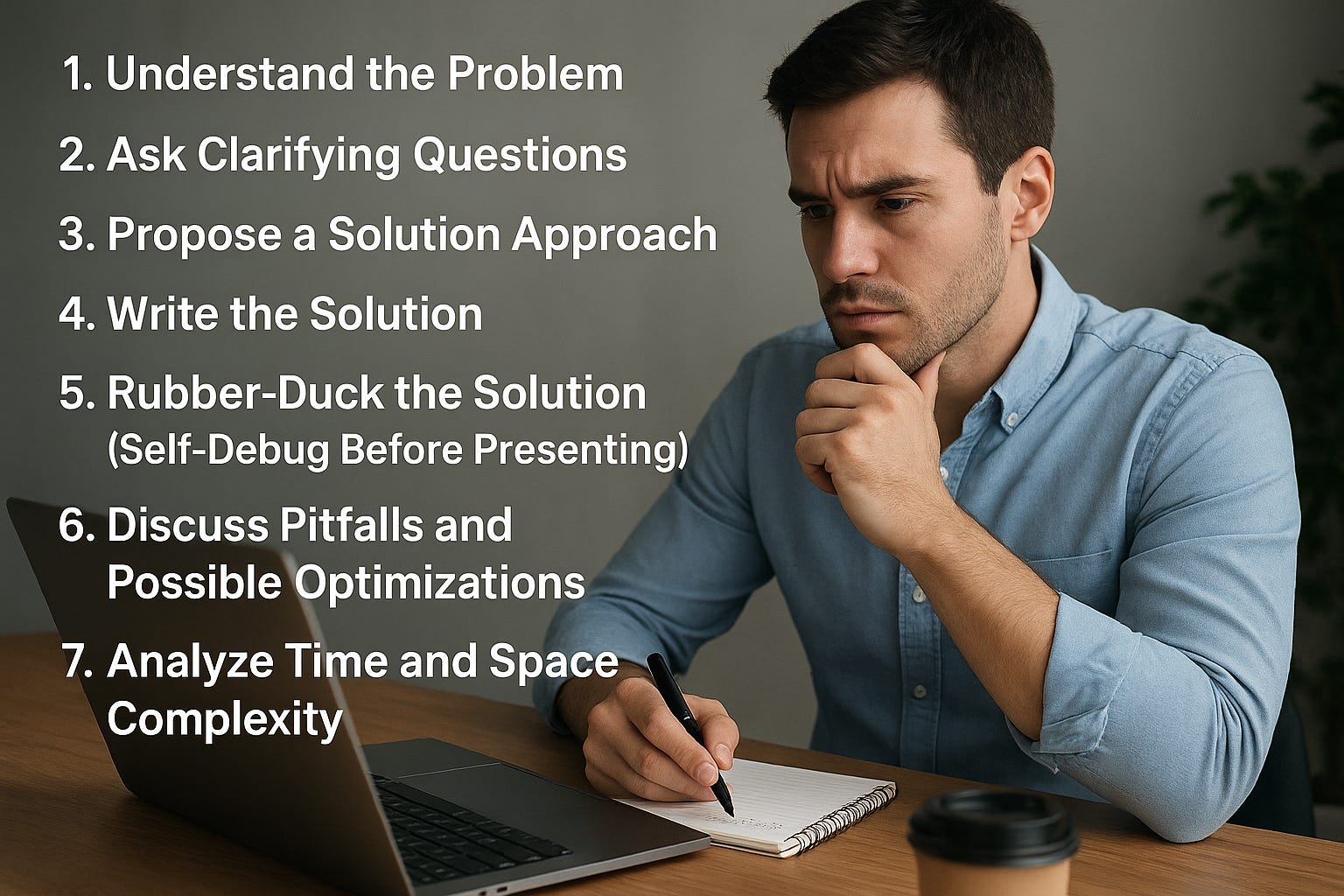
Technical interviews can feel intimidating, but once you understand the structure behind them, they become much more manageable. Most successful candidates follow a consistent, methodical process to demonstrate not just coding skill, but communication, reasoning, optimization, and clarity of thought. Below is a breakdown of the workflow during a coding interview.
1. Understand the Problem
Before writing a single line of code, the first job is simply to understand.
Rushing to solve a misunderstood problem is one of the most common interview failures.
Take a moment to restate the prompt in your own words. Confirm inputs, outputs, constraints, and edge cases. This demonstrates controlled thinking and prevents rework later.
2. Ask Clarifying Questions
Clarifying questions are not a sign of weakness — they show senior-level thinking.
Examples include:
“Can the input be empty?”
“Are duplicates allowed?”
“Is the data already sorted?”
“What are the time or memory constraints?”
Interviewers expect this. The quality of your questions often signals your maturity as an engineer.
3. Propose a Solution Approach
Before coding, explain how you intend to solve the problem.
You might outline:
brute-force approach
optimized approach
relevant data structures
trade-offs
This conversational step aligns you with the interviewer and prevents wasted time. If you’re off track, the interviewer will nudge you.
4. Write the Solution
Now translate your reasoning into code.
During this step:
narrate what you’re writing
keep your code clean
handle edge cases
prefer readability over clever tricks
Remember: the interviewer values clarity over micro-optimizations at this stage.
5. Rubber-Duck the Solution (Self-Debug Before Presenting)
Before you announce “I’m done,” walk through your code line by line as if explaining it to a rubber duck.
Imagine inputs tracing through:
happy path
boundary cases
invalid data
performance concerns
This step helps you catch bugs before they become visible.
6. Discuss Pitfalls and Possible Optimizations
Once the core solution works, demonstrate forward-thinking:
What could break?
What assumptions did you make?
Could this fail at scale?
Is there a more optimal approach?
Interviewers love candidates who proactively identify weaknesses.
7. Analyze Time and Space Complexity
Finally, evaluate the Big-O characteristics of your solution:
runtime complexity
memory footprint
bottlenecks
alternative trade-offs
This step proves you can think like a systems-level engineer, not just a coder.
🎯 Conclusion
A great technical interview isn’t about solving a problem fast.
It’s about demonstrating clarity, communication, correctness, and optimization.
By following this structured process:
Understand
Clarify
Propose
Code
Debug
Evaluate
Analyze
…you present yourself as a thoughtful engineer who solves problems deliberately and professionally — exactly what interviewers want to see.